¡JUEGA!


Where are the female reproductive organs?

Most of the female reproductive organs are inside the body.

• Two ovaries, one on the left and the other on right of the body, produce ova. These are the female reproductive cells.
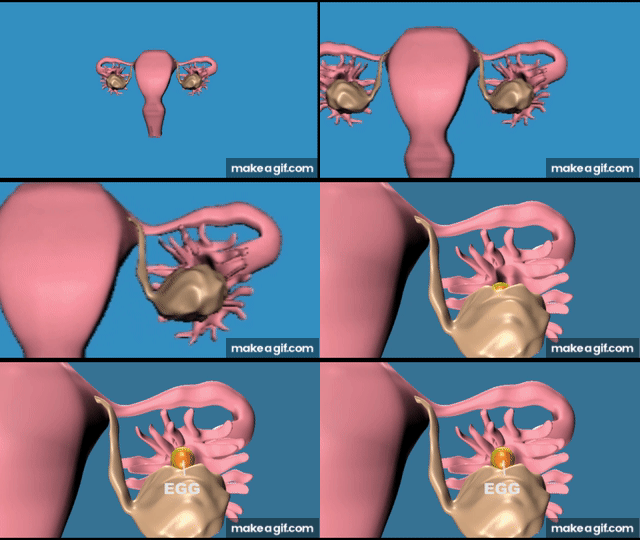

• Fallopian tubes connect the ovaries to the uterus.

• The uterus is a hollow, muscular organ. During pregnancy it expands to hold the growing foetus. The cervix is at the bottom of the uterus, separating it from the vagina.

• The vagina connects the interior reproductive parts to the outside of the body.
• The vulva is the external part of the female reproductive system. It is formed of folds of flesh called labia, which protect the entrance to the vagina and the opening of the urethra.

Where are the male reproductive organs?

Most of the male reproductive organs are outside the body.
• The testicles are two organs within the scrotum. They contain the testes, which are the glands that produce spermatozoa.

• The penis is a tube-shaped organ with many nerve endings. The urethra runs down the penis to an opening at the tip. During reproduction, spermatozoa leave the penis and enter the vagina.

The prostate and the seminal vesicles are accessory glands that are located inside the body.
The testes are connected to the accessory glands via the vas deferens. These glands produce a fluid that mixes with the spermatozoa to produce semen. Semen is released down the urethra.

How are the male and the female reproductive cells different?
Both male and female reproductive cells, or gametes, are needed in human reproduction. The ovum is the largest cell in the human body. The spermatozoon is much smaller and more mobile.


When does the reproductive system develop?

Babies are born with a reproductive system, but it is not fully developed in the first years of life. From the ages of about eleven to seventeen, the reproductive system develops and becomes mature. This is called puberty and causes physical changes in everyone.
It also leads to emotional development.
• Inside the body, the reproductive system becomes active.
• The exterior of the body changes as secondary sexual characteristics appear.
• Puberty can be a difficult time for many adolescents, as hormonal changes affect their emotions.
• Towards the end of puberty, emotions become more stable. Mental maturity includes a sense of responsibility and of the consequences of actions. Adulthood includes both sexual and mental maturity.

Which body systems take part in nutrition?

In the human body, four systems work together in the function of nutrition.
• The digestive system breaks down food so that the body can absorb nutrients. It also expels food that is not digested.

• The respiratory system takes in oxygen from the air and expels carbon dioxide.

• The circulatory system moves blood around the body. Blood transports nutrients, oxygen and waste substances around the body.

• The excretory system eliminates waste substances.

Which body systems take part in interaction?

The nervous system and the musculoskeletal system take part in the function of interaction.
Our sense organs detect information about our environment. The information travels through the nerves to the brain. The brain processes the information and sends an instruction through the nerves to the musucloskeletal system and other effectors.

The musculoskeletal system and other effectors carry out the instruction.

Which body systems take part in reproduction?

Human reproduction is sexual and requires a female and a male. Males and females have different reproductive organs.
HUMAN BODY SYSTEMS

PARA SABER MUCHO MÁS DE ANATOMÍA HUMANA


What is a municipality?

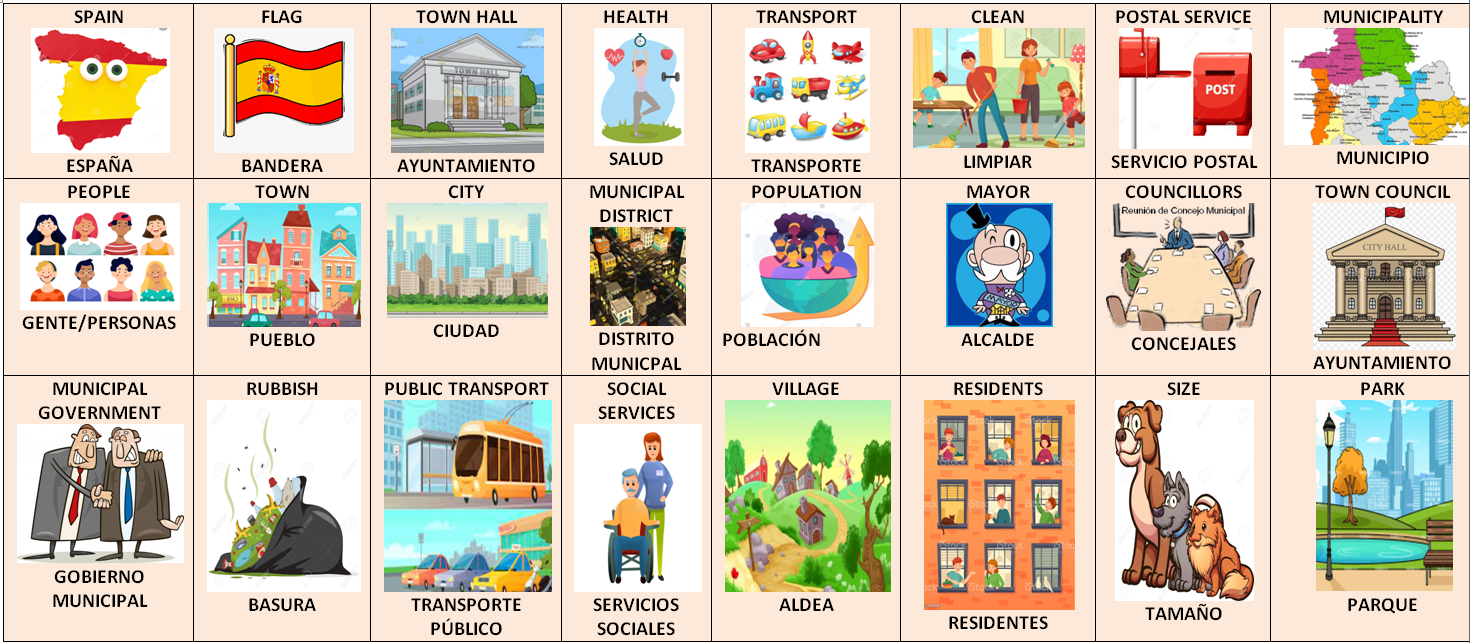
A municipality is an area where people live. It can be one or more villages, towns or cities. The territory of the municipality is called the municipal district.

The residents of a municipality are the municipal population. A municipality is governed by a town council made up of the mayor and councillors. The municipal government works in the town or city hall.

 |
| Mayor |

What does a municipal government do?
Local people elect the municipal councillors. The councillors choose the mayor. The mayor is the head of the municipal government. The municipal government is responsible for making sure we have the services we need every day. These include:
• Transport services for public and private transport.

• Health services.


• Education, sports and cultural services.


• Social services for people in need.

• Cleaning services, rubbish collection, park maintenance.